

Kura Raumati: Building the future Māori heart health workforce
Systemic barriers persist that affect entry, retention, and progression in health research and health careers for Māori, resulting in significant underrepresentation in the New Zealand research and health workforce. Māori also bear the burden of worse heart health outcomes in a health system where only 5.5% of all doctors are Māori.
Kura Raumati, a Māori-led summer research programme, is a pathway that contributes to increased Māori representation in research with a focus on heart health equity. This November, fifteen students were welcomed as the third cohort at Poutūterangi Marae in Tauranga.
The national programme funded by Pūtahi Manawa | Healthy Hearts Aotearoa NZ, Centre of Research Excellence, provides Māori students with paid, hands-on research experience. Students work with supervisors on diverse projects spanning three universities, a Kaupapa Māori general practice clinic, a Kaupapa Māori community research centre, and Te Whatu Ora.
Erina Korohina, Kura Raumati Lead and researcher, who played a key role in designing the programme, says the internship champions Indigenous ways of thinking, relating, and working.
“What we’ve seen over decades is that models and systems built without us often fail to meet our needs. We wanted to do things differently,” – Erina Korohina
Sustained Support
Kura Raumati has its whakapapa in Te Ara Poutama, a wider Kaupapa Māori research project hosted by The Centre for Health. The programme was developed and trialled by researchers with support from Pūtahi Manawa and The National Heart Foundation. Now in its third year, the programme has been entrusted to Pūtahi Manawa to carry forward beyond the life of the original research project.
“Too often, research produces incredible initiatives for communities, only for them to end when the project wraps up. Being able to carry this kaupapa forward for Māori students is a privilege, and an important step in strengthening the Māori heart health workforce.” – Associate Professor Karen Brewer, Pūtahi Manawa Co-Director Māori
Kura Raumati will be sustained for three more summers, the duration of Pūtahi Manawa's current funded contract with the Tertiary Education Commission.
But Professor Paton, Co-Director of Pūtahi Manawa, says longer-term investment is essential for the fruits of programmes like Kura Raumati to be realised and heart health equity through workforce development addressed.
“We are planting the seed for a career in heart health research and providing support at each step of the journey. It takes six to seven years from the beginning of an undergraduate degree to completing a PhD, studying full-time. We collaborate with Māori and Pacific STEM programmes, which support high school students, which means the potential lifespan of our relationship with a researcher could be even longer.”
A Kaupapa Māori Approach
Kura Raumati began with a week-long wānanga, providing students with direct access to diverse Kaupapa Māori research in action.
Dr Anna Rolleston, Director of The Centre for Health, says that in Te Ao Māori, Kaupapa Māori is simply doing things the Māori way. But within a Western academic context, it becomes a defined methodology with tikanga, rules, and the power to challenge established systems.
“When we choose to do Kaupapa Māori research, it is inherently political. It is a challenge to the system.”
Kaupapa Māori research tends to examine an issue holistically in a real-world context, where the environment influences outcomes, rather than in a controlled setting.
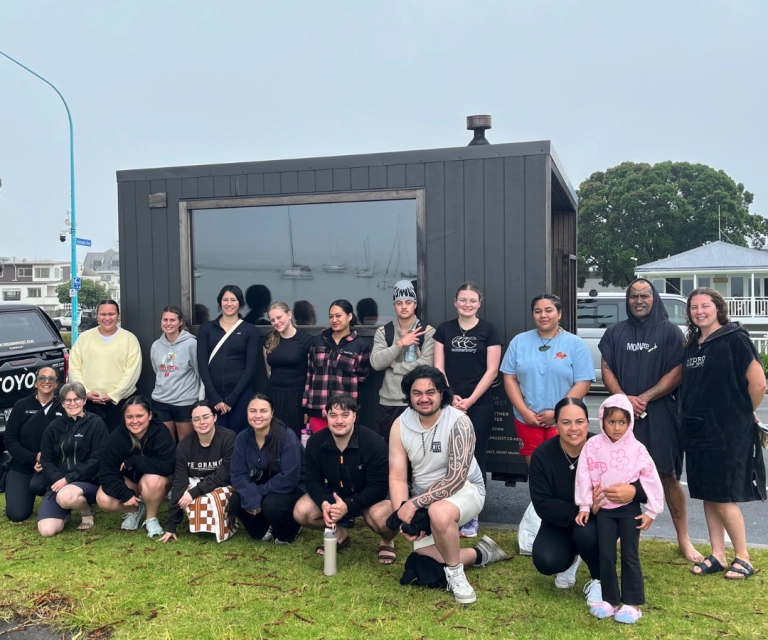
Tash Burton exemplifies this approach in her doctoral research, which investigates the cardiovascular effects of heat and cold exposure, specifically through sauna bathing and ocean immersion, as a holistic option for blood pressure management. As part of this work, Tash guided the students through a practical experience in Tauranga Moana with The Sauna Project.
Partnering for success
Kura Raumati leverages the collective's strengths and collaborates with others to diversify the students’ networks and experience. A long-standing partnership with Pūhoro STEMM Academy resulted in five of the academy’s students being placed in the 2025/26 cohort.
“This exciting collaboration strengthens our commitment to growing a diverse, culturally grounded health research workforce”, says Korohina.
Pūhoro STEMM run their summer research programme at the same time, and the crossover means the students get to experience two Kaupapa Māori programmes concurrently.
International attention
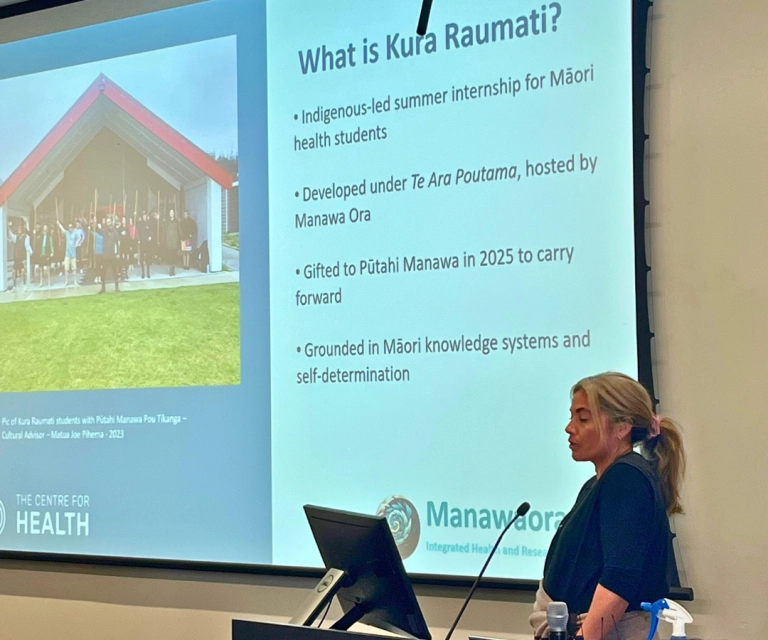
Kura Raumati was profiled nationally and internationally in 2025 by Korohina and her colleague at the Centre for Health, Whetumarama Manihera.
Korohina said that highlighting Kura Raumati locally and overseas goes beyond sharing the model and its successes.
“It’s also been a chance to connect with other Indigenous teams, swap ideas, and build relationships that can lift all our communities. Most of all, it’s about putting our tauira and their mahi in the spotlight, and showing that when Māori values lead the way, real change is possible.”