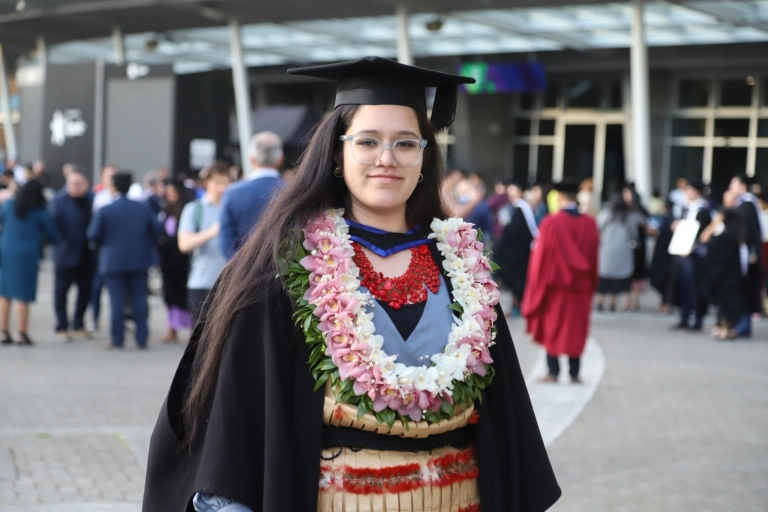

Serah ‘Otukolo: From Outreach Volunteer to Doctoral Researcher
When Serah ‘Otukolo missed out on medical school, she never imagined the setback would open the door to cutting-edge heart research. Today, she’s a Pūtahi Manawa Pacific doctoral scholarship recipient, preparing to work on a world-first pacemaker project.
A Lesson in Faith
Serah began her studies at Waipapa Taumata Rau | University of Auckland with dreams of becoming a doctor. Supported by her family, she threw herself into her first year of biomedicine, only to face a tough reality.
“That was a big challenge for me. I was completely not ready for university, and didn’t make it into medicine. That really stayed with me for my whole undergrad degree—the rejection, and feeling like I wasn’t good enough.”
But connections she made in biomedicine would open new doors—and a new passion.
Finding Her Spark
A pivotal moment came when Professional Teaching Fellow Dr Anuj Bhargava invited Serah into outreach programmes, encouraging more Māori and Pacific high school students into science. There, she met Pūtahi Manawa Co-Director Professor Julian Paton.
“I read about the pacemaker he’d developed and thought it was so cool—I even made my family sit down and watch the video with me,” she recalls.
Another outreach event introduced her to Dr David Crossman, Director of the Biomedical Research Imaging Unit, who became her supervisor. A summer studentship under his guidance gave Serah her first real taste of research—on the very pacemaker she had been inspired by.
“Here I am buzzing about it, and now I can actually do some work on it. That was a crazy feeling.”
Research with Impact
The new “natural” pacemaker, developed by Professor Paton and colleagues, changes pace with breathing and is already in clinical trials. Serah’s research dives into the microscopic effects of this device, using advanced imaging to understand how it could improve outcomes for heart failure patients—particularly Māori and Pacific communities who face higher rates of hospitalisation at younger ages.
“Māori and Pacific People bear the biggest burden of heart failure; we need more effective treatments. If we're seeing it more, we do need to be doing something about it”, she says.
Serah’s motivation is deeply personal, too. Since making it into medicine after her biomedical degree, she is already a go-to person for health advice among her family and wider community, and has seen firsthand how cultural barriers can lead to dangerous misunderstandings. “Misunderstanding a diagnosis is huge—even fatal. Bridging those gaps is really important to me.”
Looking Ahead
After presenting her first summer research project, both Professor Paton and her father told Serah she would go on to a PhD. “I thought they were crazy. There’s no way I thought I could do that,” she laughed.
Crossman remarked, “Julian and I encouraged her toward a PhD because she has the talent, drive, and creativity to thrive, and we are passionate about supporting Pacific talent to flourish in biomedical science.”
Now, with the backing of her mentors, she is preparing to begin her doctorate in 2026, with plans for international collaborations at the University of Oxford and the University of Bern before returning to complete her medical degree.
“When I look back, I realise everything happens for a reason. If I hadn’t missed out on medicine the first time, I wouldn’t have met Anuj, found Pūtahi Manawa, or discovered this path. I’ve been really blessed.”