

Bringing a lifetime of community, faith and service to research
Penina Hitti came to health research after years of raising her family and contributing to her community. When she began looking for a way back into the workforce, a friend and Professor at Massey University suggested she take on project management roles in Pacific health research.
With her youngest twins in their third year of school, Penina was ready for a new chapter. She brought her teaching experience and commitment to her community into a research role, with no idea at the time where the opportunity would lead.
Working on research projects gave Penina a close look at how studies were designed, delivered and evaluated. It also left her with plenty of questions about what happened after the research was finished.
“The projects were mostly intervention-based, and I was always wondering whether there was another way to do things, how we could do things smarter and make a bigger difference”, she says.
Those questions eventually led her back to study. With support from Health Research Council funding, Penina completed a Master’s degree focused on spiritual health, an area she felt was often overlooked in discussions about Māori and Pacific wellbeing.
The experience, although overwhelming, reinforced her interest in research that could have a practical benefit for communities. After a year more of working in project management in Pacific research, her Master’s supervisor sent her the Pūtahi Manawa fellowship opportunity that would allow Penina to also work towards a PhD. She jumped at the chance, but thought hard about what it was that she could contribute to Pacific communities that would be broad enough to help a lot of people, but also have an impact immediately.
“Some studies say it can take about 14 years for research findings to be implemented in communities,” she says. “For me, that’s too long.”
Now, as a Pūtahi Manawa research fellow and PhD candidate, Penina is investigating how childhood experiences are associated with mental and metabolic health in Pacific communities. Her research considers adverse childhood experiences (ACEs), and the positive experiences, relationships and environments that may support resilience and wellbeing.
Asking what might be missing
Penina’s PhD draws on the Fonofale model, which takes a holistic view of health, recognising the connections between physical, mental, spiritual, cultural and social wellbeing. It is an approach that reflects how she sees health in her own life, too — as something shaped by more than what happens in the mind or body.
“As well as strengthening my mind through study, I’m training for my black belt in Taekwondo this year.”
For Penina, staying well means making space for the things that keep her grounded: faith, family and community, alongside her research and the physical challenge of Taekwondo.
As part of her research, she is also examining the widely used Adverse Childhood Experiences (ACEs) framework. ACEs research has identified a range of childhood experiences associated with poorer health later in life, but Penina believes there is more to consider when applying the framework to Pacific populations.
“The framework is incredibly valuable and supported by strong evidence,” she says. “But there are experiences that Pacific communities know have an impact that aren’t included.”
Her research considers factors such as spirituality, racism, migration experiences and the effects of colonisation, asking whether they should form part of the way childhood adversity is understood for Pacific communities.
“We know these things are negative childhood experiences, but they're invisible in the standard ACEs list”, she says. “we agree with the 10 that are there, but for our context, we need these other five to be considered when we are looking at mental health for our Pacific population”
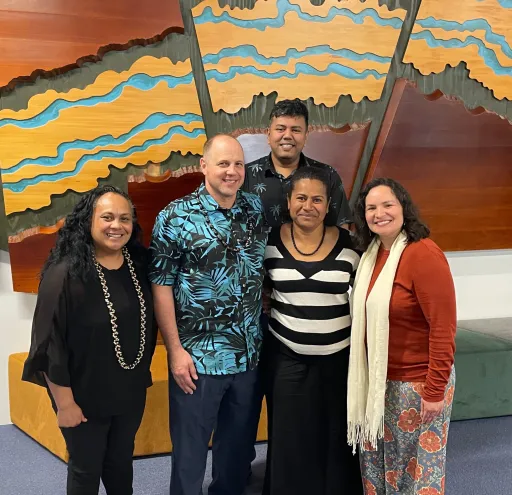
presented her Pūtahi Manawa-funded PhD project to her academic peers.
For Penina, that question is part of a wider issue in health research: whether the measures and frameworks being used are capturing the relevant experiences for the population.
A strengths-focused approach
Another important part of Penina’s research is what happens alongside adversity.
Rather than focusing only on experiences that can increase the risk of poor health, she is also looking at positive childhood experiences and their relationship with resilience and wellbeing.
The quantitative phase of her research has already produced some unexpected results. While the relationship between childhood adversity and poorer mental health was relatively clear, the connection between childhood adversity and metabolic health was more complicated than anticipated.
“The numbers tell us something important, but they don’t tell us everything,” she says.
The next stage of the research involves in-depth interviews with people whose experiences and health outcomes differ. These conversations will allow Penina to explore some of the stories behind the patterns emerging from the data.
She wants to understand what helped people cope, what relationships or community experiences made a difference, and what may have protected their wellbeing.
“Those are the insights that communities can actually use.”
Making research useful
Penina’s experience outside academia continues to influence how she approaches research.
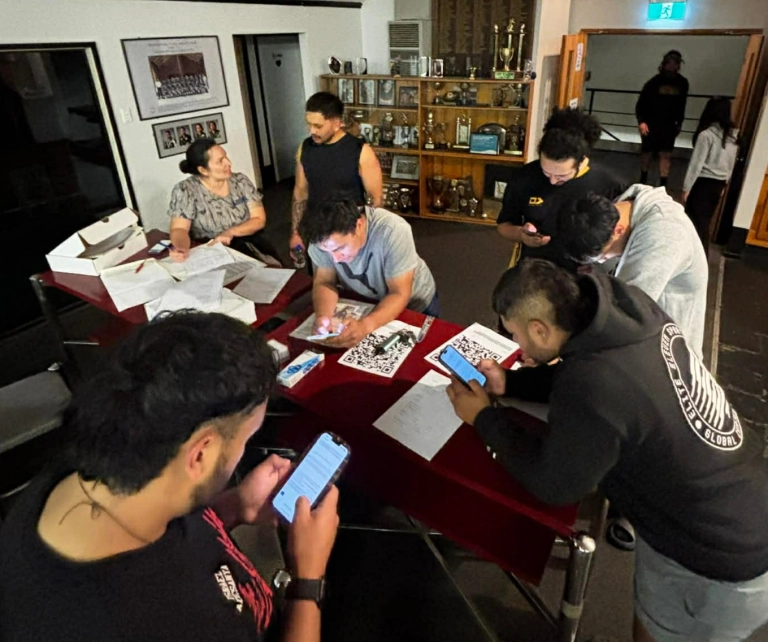
She does not want community involvement to be limited to participating in a study or receiving a report once the research is complete. Participants are regularly updated on the progress of her research, and community members are helping shape how the findings could eventually be shared.
That could mean moving beyond the traditional research report or conference presentation. Penina is exploring approaches such as Pacific inspired creative workshops and Forum Theatre, an interactive form of performance that allows people to explore real-life situations and possible responses.
“I want the research to be useful,” she says. “I don’t want it sitting on a shelf.”
The same principle applies to the language used to communicate research.
“If I leave it at the level of academic jargon, it stays in academia,” she says. “I want people to be able to read it, understand it and use it.”
From questions to action
Penina’s path into research began with questions she encountered while working alongside researchers. Those questions have since developed into a PhD exploring how early-life experiences can shape health across the lifespan.
By understanding how childhood experiences can shape metabolic and mental health later in life, there may be an opportunity to intervene much earlier.
“If we're trying to figure out what to do when they're 50 or 60, it's too late,” Penina says.
The consequences of poor health later in life extend beyond the individual, affecting families, communities and the health system. Penina believes that understanding these pathways earlier could help prevent illness before it takes hold, reducing not only its physical impact but also the wider social and economic costs.
The Pūtahi Manawa fellowship has given her the opportunity to focus on that work without the financial pressures that came with balancing postgraduate study, employment and family responsibilities during her Master’s degree.
Her research is ultimately concerned with a question that extends beyond the data: what can we learn about the experiences that shape health early in life, and how can that knowledge be used?
Penina believes that one part of the answer is creating environments where children and communities have the support they need to thrive.
“Creating nurturing environments for children in our community allows our community to remain healthy long-term,” she says.
Bringing the community along as the research unfolds, is one way Penina will ensure the findings that demonstrate a nurturing environment can be implemented right away.
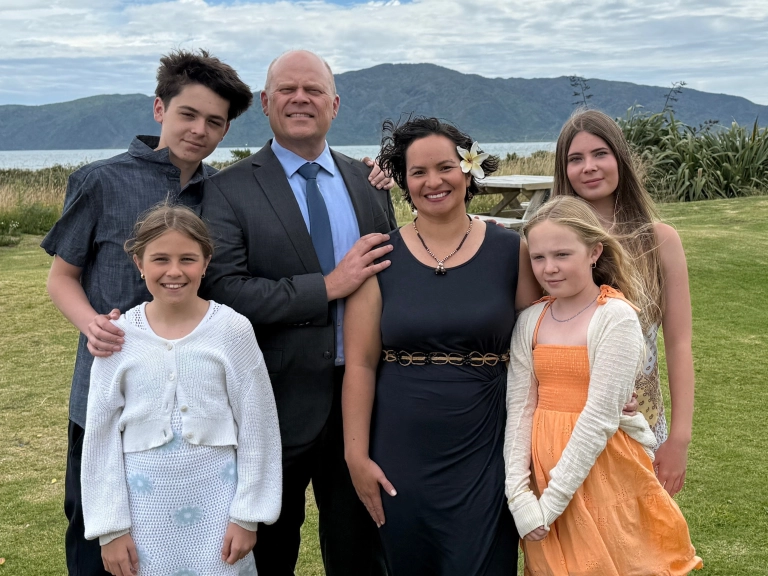
Header Image: Penina Hitti with her husband, Matt, and their four children on the Kāpiti Coast.